
Smell & taste changes after a brain injury

Smell and taste changes after a brain injury are incredibly common and are often influenced by the severity of the brain injury and/or the interval of time since the injury. Can you imagine what it would be like if your favourite food didn’t have any flavour at all? What would you do if everything you ate tasted terrible?
Statistics on the incidence of olfactory (smell) dysfunction after a brain injury vary widely, but range anywhere from 12.8 – 68% depending on the tests and cut-offs used.1,2 About 8% of people after a brain injury will have a complete loss of smell, which is called anosmia.3
True changes to “taste,” meaning changes to the tongue’s ability to detect sweet, salty, sour, bitter and umami flavours, are believed to be much less common (after a brain injury and in general). Taste changes may include a reduced (or absent) sense of taste or a distorted sense of taste. There are very few statistics available on the incidence for this.4
Taste and smell are often experienced simultaneously when someone eats. The tongue transmits information to the brain on whether the food is sweet, sour, salty, bitter or has an umami flavour, while smell molecules simultaneously travel up the back of the throat into the nose where they stimulate the olfactory nerves and provide information on the food’s flavour (e.g. is that sweetness from a mango or a peach?) Most people are surprised to discover that the majority of a food’s flavour actually comes from the “smell” molecules. You can test this out yourself by pinching your nose closed while you eat something that has an aroma to it. Pay attention to what flavours you can detect while pinching your nose closed and then release your nose to see how the experience becomes very different.
When clients say their food tastes “bland” or has “no taste,” what they usually mean is the food has no flavour. It can be difficult for people to figure out by themselves, if the problem is actually their sense of taste or their sense of smell. In most cases, “bland” or “tasteless” food is caused by a diminished sense of smell, but not always. The only way to determine the root cause of the problem is for a health professional to test someone’s sense of smell and taste separately. Both can be formally tested at taste and smell clinics around the UK (for a complete list click HERE), but other professionals can do more informal testing with clients using Sniffin’ sticks, unmarked smell pots and/or Burghart taste strips as well.
Many clients with olfactory dysfunction are not even aware that they have it. Health professionals therefore need to pay attention to subtle clues that would indicate that there may be a problem, like clients saying their food is “bland” or “tasteless” or clients adding excessive amounts of salt or sugar to their food. Clients who ARE aware of their changes to flavour perception often get less pleasure from eating and may revert to takeaway or ready meals since they see little point in cooking. This can affect both their weight and their nutritional status.
How to enjoy food when flavour has been affected
Eating is a multi-sensory experience, meaning we use ALL of our senses to enjoy a good meal (whether we are aware of it or not). This also means that if one of our senses becomes impaired, it’s critical that we “dial up” all of the other senses in order to compensate for this.
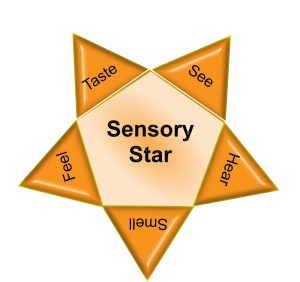
Here are some examples:
1. Maximise the visual appearance of food
People often “eat with their eyes” and will be more interested in eating something which looks delicious. Focus more on the visual appearance and presentation of food on the plate and the variety of colours presented (e.g. stir fried vegetables or beautifully coloured smoothies).
2. Enhance the smell
If someone has even a bit of smell function remaining, adding more fresh herbs, spices and extracts (e.g. vanilla) to dial up the smell of food (to a detectable level) can help a lot. It’s worth noting that fresh herbs have significantly more flavour than dried varieties.
3. Add more sour, bitter and umami flavours
Most people with smell impairments will automatically gravitate towards adding more salt or sugar to their food which can have negative health consequences. Instead, encourage clients to add more:
- Sour – e.g. vinegar, lemon juice, pickles
- Bitter – e.g. rocket, bitter gourds, grapefruit, beer (e.g in a batter)
- Umami – e.g. Marmite, Worcestershire sauce, parmesan cheese, mushrooms, tomatoes and soy sauce
- Sweetness – e.g. fruit
4. Listen to the “sound” of food
Most people don’t pay much attention to how their food “sounds,” but you would be amazed at what a difference it makes to the eating experience! Be sure to include “crunchy” foods at a meal, eat seafood while listening to the sound of the ocean or play a soundtrack of food sizzling or bubbling to see how that changes flavour perception and the enjoyment of eating.
5. Focus on how the food “feels” in the mouth
Most people with smell or taste loss still have an intact trigeminal nerve. This nerve tells the brain if food/fluid in the mouth is considered hot or cold, what texture it is, whether it makes the tongue burn or tingle or feel dry or whether bubbles or carbonation are present. Stimulating this nerve often gives people with an impaired sense of smell or taste the most enjoyment from eating and is therefore the primary strategy used to compensate in these situations. Here are some examples of ways to stimulate the trigeminal nerve:
- Contrasting temperatures – e.g. pair hot curry with cold yogurt or hot porridge with cold banana.
- Texture – e.g. combine crunchy, chewy and smooth foods at the same meal (such as adding water chestnuts and almonds to stir fried vegetables).
- Tongue-tingling – e.g. add hot sauce, horseradish, mustard, garlic, ginger and menthol to create a “burning” or “cooling” sensation on the tongue.
- Astringency – e.g. include more rhubarb, the skin of black grapes and green bananas to give the sensation of “drying” the tongue.
- Carbonation – e.g. drink more sparkling water (plain or with pure fruit juice) for a healthier alternative to fizzy drinks.
Compensation strategies are just one area to consider when someone has smell or taste changes.
Smell training
Smell training has been found to improve smell function in 36% of people after a brain injury. Smell training is a bit like “physio for the nose” and involves smelling 4 different scents twice daily for about 4-6 months.
For more information on smell training go to:
- Smell training after a brain injury (Specialist Nutrition Rehab)
- Smellability Toolbox (Fifth Sense)
- Welcome to smell training (Abscent)
Safety
Smell loss comes with certain safety risks, like the inability to tell if there is a fire or a natural gas leak. For more information go to:
- Safety tips for people with smell loss (Specialist Nutrition Rehab)
- Smell safety (Fifth Sense)
Taste & Smell Clinics
For more information on where to refer clients if they need further investigation regarding their smell or taste changes, go to:
- UK & International Clinics (Fifth Sense)
- Smell and taste loss…how to cope (Specialist Nutrition Rehab)
Taste Disturbances
To watch the Fifth Sense 1 hour 15 minute multi-disciplinary presentation on “Taste Disturbances” aimed at the general public and health professionals, go to:
- Towards an Understanding of Taste Disturbance (Sheri Taylor from Specialist Nutrition Rehab speaks at 00:35:00).
Dietitians at Specialist Nutrition Rehab routinely assess clients for taste and smell loss as part of their initial dietetic assessments. To make a referral or for more information, contact us at 0121 384 7087 or info@specialistnutritionrehab.co.uk.
For more articles like this delivered straight to your inbox, please sign up for our free e-newsletter below.